Contact Us
- A.Yeung@leadmenspacking.com
- +8618933322747
- Building 4, No. 223, Guangcheng Road, Jiuzhouji, Xiaolan Town, Zhongshan City, Guangdong Province
The “temperature password“ for high temperature resistance of aluminum foil sealing film
Aluminum foil sealing film is highly favored in many industries such as food, medicine, cosmetics, etc. due to its excellent sealing, barrier properties, and preservation ability. However, a common and crucial question arises: can it withstand high temperature environments? The answer is yes, but there are some considerations.
Leadtra Packaging will provide you with an in-depth analysis of the high temperature resistance of aluminum foil sealing film, helping you make the safest and most suitable choices in different application scenarios.
Aluminum foil sealing film usually has good high temperature resistance. But this is not a simple "yes" or "no" answer, as the upper limit of its temperature resistance mainly depends on the structure of its composite material, rather than a single aluminum foil layer.
The aluminum foil sealing film we see in our daily lives is actually a multi-layer composite structure, usually consisting of an outer protective layer (plastic), an aluminum foil barrier layer, a heat sealing layer, and an adhesive that bonds them together. The temperature resistance of each layer of material collectively determines the final performance of the entire product.
In depth analysis: the "temperature password" of each layer of material
Aluminum foil layer: a sturdy 'skeleton'
The melting point of aluminum metal itself is as high as about 660 ° C, and it will not melt at all at the temperature of conventional packaging applications (usually below 200 ° C).
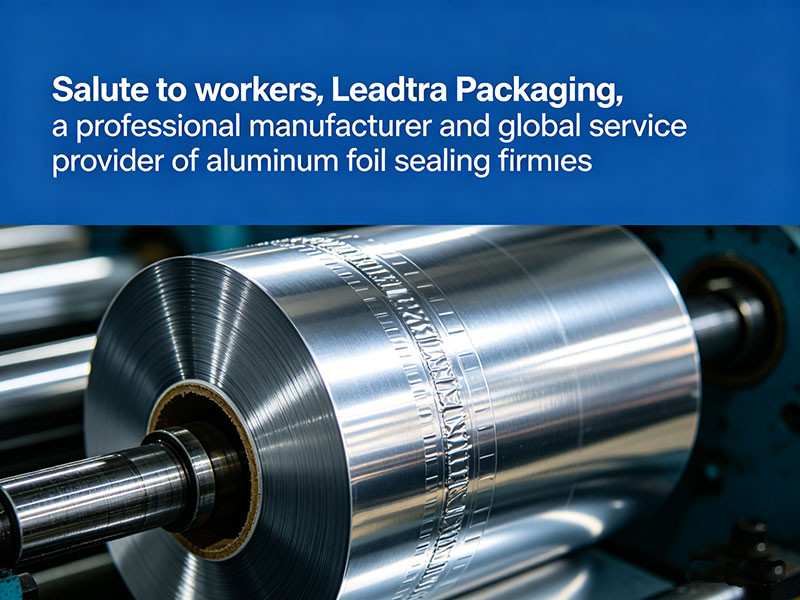
Its core function is to maintain structural stability at high temperatures, without decomposition or the production of harmful substances, providing solid physical support and the strongest barrier properties.
Plastic and heat sealing layer: key 'shortcomings'
This is the key to determining the temperature resistance performance. The outer plastic layer (such as PET or PP) and the inner heat sealing layer (such as LDPE or CPP) are both polymer materials with specific melting points and long-term use temperature ranges.
PET (polyester): Excellent heat resistance, can withstand 150 ° C-200 ° C in the short term, suitable for high-temperature cooking and baking environments.
PP (polypropylene): It has good heat resistance and a melting point of about 160 ° C-170 ° C. It is commonly used in products that require high temperature sterilization.
Heat sealing layer (such as LDPE): with a low melting point (about 105 ° C-115 ° C), it determines the temperature required for sealing and also limits the lower limit of overall temperature resistance.
Adhesive: an invisible 'bond'
The adhesive used to bond each layer must also have corresponding temperature resistance to ensure that it will not delaminate or fail during high-temperature sterilization or storage.
Leadtra Packaging is a professional manufacturer and global service provider of aluminum foil sealing film, providing one-stop services for sealing film, sealing gasket products and solutions. We are stationed in the factory for debugging, solving your sealing problems, and ensuring your production cycle. If you are interested in or have any questions about us, please feel free to call us for consultation.
“Recommend”
【editor】:Leadtra PackagingCopyright:https://www.leadmenspacking.comReproduced please indicate the source