
Contact Us
- A.Yeung@leadmenspacking.com
- +8618933322747
- Building 4, No. 223, Guangcheng Road, Jiuzhouji, Xiaolan Town, Zhongshan City, Guangdong Province
Can sealing gaskets be used on plastic bottles?
That's a very practical question — worrying about damaging the bottle mouth is almost the first concern anyone has when first encountering aluminum foil sealing gaskets. The answer is: Yes, they can be used. And as long as you use the right method, they won't damage the bottle mouth.
The key lies in "contactless" heating
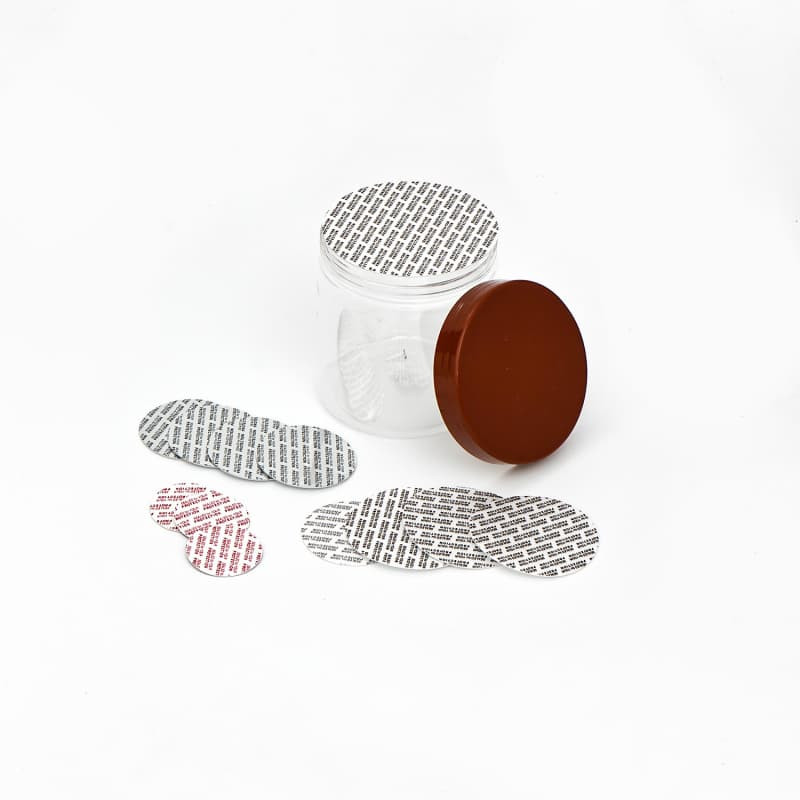
The principle behind aluminum foil sealing gaskets is electromagnetic induction heating. Simply put, the sealer generates a high-frequency electromagnetic field. When the aluminum foil gasket inside the cap passes through, the foil heats up by itself. The heat acts only on the aluminum foil layer, melting the adhesive layer underneath onto the bottle mouth — and that's it. Throughout the whole process, the machine never directly touches the bottle, nor does it rely on an external heat source.
Where does the heat go?
Heat is generated from the aluminum foil, conducting downward to the heat-seal layer and upward to the paperboard layer. The downward heat is absorbed by the bottle mouth to fuse the seal, while the upward heat is blocked by the paperboard — never directly contacting the plastic bottle body. As long as sealing parameters are set correctly, induction heating is precisely controlled within 130-180°C, and the duration is only one to two seconds — not enough time to warp or damage the bottle mouth.
So how do you avoid damage?
Choose the right formulation for the material. PET bottles, PE bottles, and PP bottles have different affinities for the heat-seal layer. Industry standards recommend specific composite structures for different bottle materials: PET/A1/PET for PET bottles, PET/A1/PP for PP bottles, and PET/A1/PE for HDPE bottles. Using the wrong formulation can lead to poor sealing or heat damage.
Adjust equipment parameters. The power and timing of the electromagnetic induction sealer directly affect sealing results. Too much power or too long a cycle can cause excessive heating, potentially burning the heat-seal layer or even softening localized areas of the plastic bottle mouth. It's recommended to run small-batch tests during the sampling stage to find the optimal combination of settings.
Keep the bottle mouth clean and smooth. Burrs, uneven surfaces, or oil residue on the bottle mouth can affect sealing uniformity, leading to localized overheating.
If you're unsure which gasket structure suits your plastic bottles, simply send a few bottles to Leadtra Packaging. We can match the most suitable gasket solution based on your bottle mouth material. You'll never know what works best until you try.
“Recommend”
【editor】:Leadtra PackagingCopyright:https://www.leadmenspacking.comReproduced please indicate the source