
Contact Us
- A.Yeung@leadmenspacking.com
- +8618933322747
- Building 4, No. 223, Guangcheng Road, Jiuzhouji, Xiaolan Town, Zhongshan City, Guangdong Province
Do Seal Liner Work for Both Wide-Mouth and Narrow-Mouth Bottles?
Clients often ask: "Can seal liner be used on wide-mouth bottles? Won't narrow-mouth bottles be too small to seal properly?" The answer is simple: both work, but the selection logic is different. Bottle size determines how to choose the liner, which material to use, and what sealing effect to achieve. Leadtra Packaging breaks it down for you.
What's the Difference Between Wide-Mouth and Narrow-Mouth Bottles?
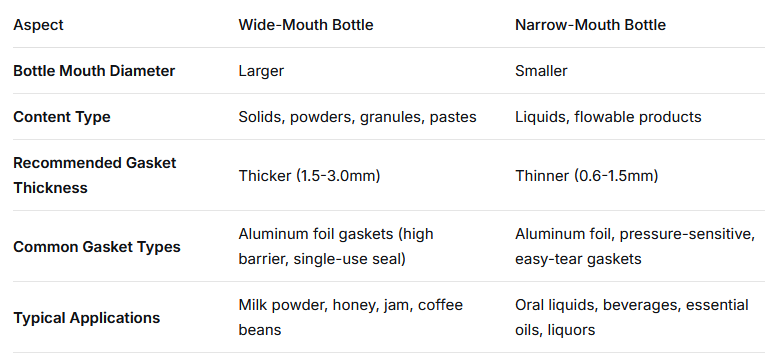
Wide-mouth and narrow-mouth bottles are distinguished by their inner diameter. Wide-mouth bottles have a relatively large inner diameter and are commonly used for solids, powders, granules, or pastes — such as honey jars, milk powder cans, jam jars, coffee bean containers, etc. Narrow-mouth bottles have a smaller diameter and are more often used for liquids and flowable products — such as beverages, sauces, flavored oils, liquors, and the like.
Key Considerations for Wide-Mouth Bottle liner Selection
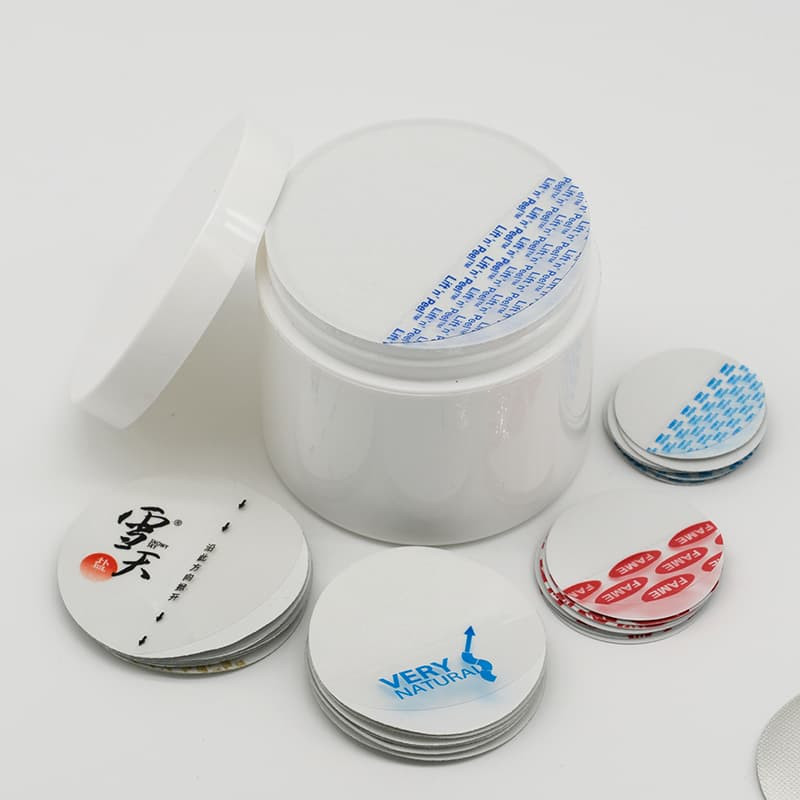
Wide-mouth bottles are large-diameter containers, and the gap between the bottle mouth and cap is generally larger, requiring a thicker liner to fill this space. According to available information, liner thickness typically ranges from 0.6mm to 3.0mm. For wide-mouth bottles, thicker liner are usually recommended to ensure sufficient compression when the cap is tightened to fill the gap and create a stable seal.
Additionally, wide-mouth bottles often contain solids or pastes (such as milk powder, honey, sauces), which have higher moisture and freshness protection requirements. For this reason, aluminum foil liner are commonly used for wide-mouth bottles. Through induction heating, the aluminum foil layer fuses to the bottle mouth, creating an irreversible seal with more reliable oxygen and moisture barrier properties.
Key Considerations for Narrow-Mouth Bottle liner Selection
Narrow-mouth bottles (such as oral liquid bottles, small beverage bottles, flavored oils) have small diameters with relatively uniform cap gaps. A thin, small-diameter liner works perfectly — there's no need for a thicker one. The main consideration is matching the liner to the bottle's sealing surface design. Narrow-mouth bottles often have specific thread fits between the cap and bottle mouth, and the liner needs to conform to the top sealing surface or side sealing surface of the bottle mouth to ensure effectiveness.
Narrow-mouth bottles frequently contain liquids or volatile products, requiring liner with good barrier properties to prevent leakage. Commonly used options include aluminum foil liner (for induction sealing) or PTFE composite liner (for corrosion resistance). For small-diameter reagent bottles, essential oil bottles, etc., aluminum foil liner with easy-tear designs or pressure-sensitive liner are often used for easy opening and re-closing.
Comparison Summary Table
Final Thoughts
Wide-mouth and narrow-mouth bottles do have different requirements for seal liner. Wide-mouth bottles typically need thicker, higher-barrier liner to handle larger gaps and higher moisture protection demands. Narrow-mouth bottles, by contrast, emphasize precise matching to the bottle's sealing surface and ease of opening.
If you're unsure which liner type, thickness, or structure suits your product, feel free to send your bottle samples to Leadtra Packaging. We can match the right liner solution based on your bottle dimensions, content characteristics, and application scenarios. A good seal starts with choosing the right liner.
“Recommend”
【editor】:Leadtra PackagingCopyright:https://www.leadmenspacking.comReproduced please indicate the source